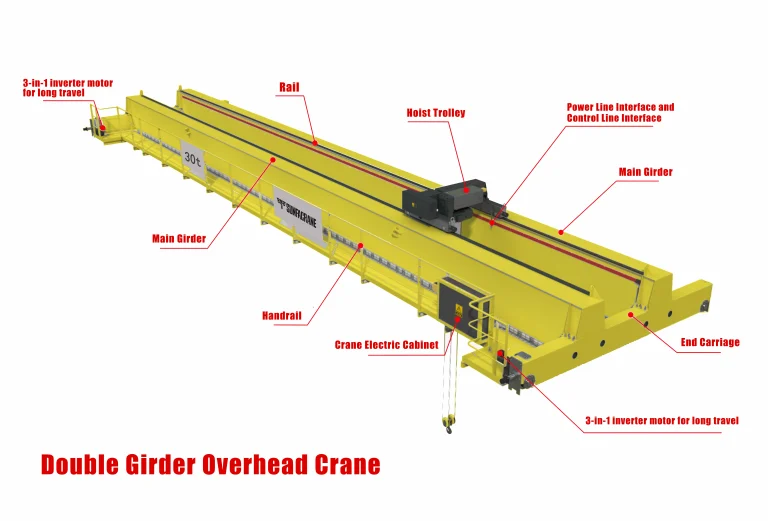
Overhead Crane Duty Cycle: Why Frequent Starts Matter as Much as Capacity
Two cranes can have the same rated capacity and still need very different specifications. A 3-ton crane that makes a few uncomplicated lifts each day does not live the same life as a 3-ton crane used for constant loading, short travel moves and fine positioning through an entire shift.
That difference is called duty. It is one of the most important parts of crane selection, yet it is often reduced to a short line on a quotation. In reality, duty is the link between the crane on paper and the way the workshop actually runs.
Capacity tells you what the crane can lift. Duty tells you how it will work.
Capacity is the maximum load the crane is designed to handle. Duty describes the operating pattern: how frequently the crane is used, how often it starts and stops, how far it travels, how much of its rated load it normally carries and how much positioning is required.
This matters because frequent starts, stops and small corrections create work for more than the hoist motor. They also affect brakes, controls, contactors or drives, rope and reeving, travel mechanisms and the maintenance programme. A crane that is sized only by capacity can be technically capable of lifting the load but poorly matched to the production rhythm.
A 3-ton crane can be light duty or very busy
Consider two typical examples.
Workshop A uses an overhead crane to unload steel stock three or four times a day. The loads are predictable, the travel path is open and the crane does not need exact placement at high speed.
Workshop B uses the same capacity crane to serve machining centres. It lifts parts many times per hour, stops at several stations, aligns fixtures and makes small positioning movements before each set-down.
Both workshops may request a 3-ton crane. Their control needs, duty classification and maintenance expectations are not the same. Workshop B needs a quotation based on the working cycle, not only the heaviest part.
The questions that define overhead crane duty cycle
Before choosing a hoist or specifying a bridge crane, collect the operating facts that are easiest to miss:
- How many lifts will the crane make per hour and per shift?
- What percentage of the rated load is carried most often?
- How high does the hook normally lift before travel begins?
- How far does the trolley and bridge travel on a typical cycle?
- How many starts, stops and direction changes happen during each transfer?
- Does the job require slow approach, exact placement or frequent jogging?
- Will the crane work in heat, dust, humidity, corrosive conditions or outdoors?
- Is the process expected to grow during the next few years?
Specific answers are much more useful than the phrase “regular use.” They help the supplier select a hoist and control arrangement that will be comfortable in the actual process.
Fine positioning creates a hidden workload
Fine positioning is common in fabrication, machining, mould handling, assembly and maintenance work. The load may only travel a short distance, but the cycle can involve many small commands: lift a little, travel a little, stop, adjust, then repeat.
This is where the control system becomes important. A simple fixed-speed crane may be suitable for a straightforward transfer route. For a process with repeated fine positioning, a two-speed option or a variable-frequency drive can provide more usable control. The best choice depends on the load, required accuracy, operator position, travel distance and production rate.
The goal is not to add every available feature. It is to make the crane predictable, controllable and maintainable for the work it will perform every day.
Choosing controls for the real job
When frequent starts and accurate placement are part of the process, discuss these points in the quotation stage:
- Hoist and travel speed: Is a single speed adequate, or does the operation need a slower approach speed?
- VFD control: Would smoother acceleration and deceleration improve handling and reduce abrupt load movement?
- Control position: Is a pendant, radio remote or cabin best for visibility and operator movement?
- Load sway: Does the route or lifting height create a repeatable sway issue that needs consideration?
- Duty classification: Does the proposed hoist and mechanism class match the real number of cycles and load spectrum?
- Maintenance access: Can the planned system be inspected and serviced safely in the installed position?
For a broad overview of the selection process, see our overhead crane buying guide. It covers the other core inputs, including span, lifting height, runway conditions and control options.
Why duty appears later in maintenance records
When a crane is under-specified for its workload, maintenance often becomes reactive. Operators report inconsistent stopping, controls feel less predictable, wear items need attention sooner, and downtime arrives at the least convenient moment. None of those symptoms should be dismissed, but the stronger solution begins before the equipment is ordered.
The maintenance plan should follow the manufacturer’s recommendations and respond to the equipment’s actual environment and use. A busy crane that performs frequent handling and positioning needs inspection records that reflect that workload. The same thinking applies to hoisting rope condition, which should be inspected according to the applicable programme. Our wire rope replacement guide explains why rope checks are more than a calendar exercise.
Avoid the most common purchasing mistake
The common mistake is simple: choosing by maximum capacity alone. It is understandable because capacity is easy to state. But the crane will live with the full operating cycle, not just the heaviest load.
Send your supplier the lifting data, cycle pattern and required positioning accuracy. A practical recommendation can then cover the bridge, hoist, speed control, control method and duty rating as one system. That approach also gives the production and maintenance teams a clearer expectation of how the crane should perform.
For factories comparing common bridge-crane options, start with the overhead crane product range and then define the application around actual use. A well-matched crane is easier to operate, easier to maintain and less likely to become a production bottleneck.
FAQ: Overhead crane duty cycle
What is overhead crane duty cycle?
It describes how the crane is used over time: lifting frequency, load spectrum, starts and stops, travel distance, operating time and the kind of positioning required.
Is crane capacity the same as duty classification?
No. Capacity is the maximum load the crane is designed to lift. Duty classification relates to the intensity and pattern of use. Two cranes with the same capacity can require different duty ratings.
Do frequent starts damage an overhead crane?
Frequent starts are part of normal operation when the crane has been selected for that workload. Problems arise when the operating pattern is not considered during specification, maintenance or control-system selection.
Should every overhead crane have VFD control?
Not necessarily. VFD control is useful when the process benefits from smoother travel, selected speeds or more controlled positioning. The decision should be based on the application, not treated as a universal upgrade.
Final thought
The best crane specification starts with one honest description: what does the operator do all day? Once the lift frequency, load range, travel pattern and positioning requirement are clear, capacity becomes only one part of a much better selection decision.