Overhead Crane Runway and Rail Alignment: Technical Checks Before Installation
Why the runway is worth checking before the crane arrives
When an overhead crane does not travel smoothly, people often look first at the motor, brake, gearbox or wheels. Those parts matter, of course. But in many workshops the real problem started earlier, in the runway beam, rail joint or building tolerance. A bridge crane can only run as well as the track it is asked to follow.
For a new project, runway and rail alignment should be reviewed before final installation. For an existing workshop, the same checks are useful before replacing a crane, increasing capacity, or changing from an older crane to a more compact overhead crane system. A few hours of measurement can prevent years of skewing, wheel flange wear and noisy operation.
Start with load data, not with the rail
The first check is not a tape measure on the runway. It is the technical data behind the crane. The crane supplier should provide the rated capacity, span, lifting height, wheel base, maximum wheel load, hook approach and duty class. These figures decide what the building structure must carry.
Maximum wheel load is especially important. A light-looking crane may still place a high point load on one runway side when the trolley is close to the end carriage. If the civil structure was designed around an estimated load, ask for the final wheel load calculation before anchor bolts, brackets and runway beams are closed in. It is cheaper to adjust steelwork at this stage than to repair cracked welds after commissioning.
Rail straightness, level and span
Once the structural design is confirmed, the practical site checks can begin. The rail centerline should be straight along the travel length, and the two rails should remain parallel. Span variation is one of the common reasons a crane starts to skew. The crane may still move, but the wheels fight the track and the operator feels it as vibration, noise or a small impact at each bay.
Rail elevation also needs attention. A small height difference over a short distance can make the bridge lean and push the wheel flange against the rail. On long travel lengths, measure level at several points instead of relying on the first and last columns only. Pay close attention to rail joints, splice plates and places where a building expansion joint crosses the runway line.
| Check item | What to confirm | Why it matters |
|---|---|---|
| Rail span | Consistent distance between the two rail centerlines | Reduces skewing and uneven wheel pressure |
| Rail level | No sudden elevation change between adjacent measuring points | Helps the bridge travel without side thrust |
| Rail straightness | No visible bend, kink or offset at rail joints | Prevents flange wear and wheel impact |
| End stops | Stops are aligned, welded or bolted correctly, and matched to buffers | Protects the crane and building during end travel |
Runway beams and brackets
Runway beams must be checked as carefully as the rails on top of them. Look for full contact under rail pads, clean bearing surfaces, proper tightening of rail clips and clear weld quality at brackets. A rail that is straight during installation can still move later if clips are loose or the supporting beam twists under load.
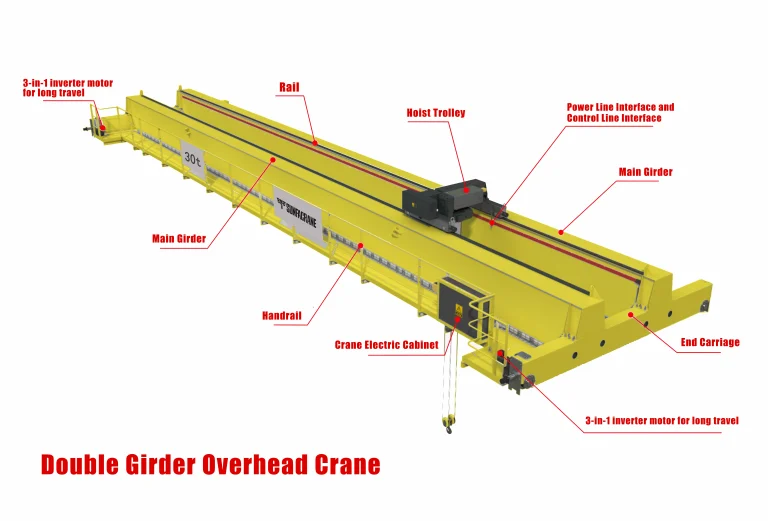
For workshops using a single girder overhead crane, the structure is usually lighter, but alignment is still important because the electric hoist travels under the main beam and repeated skewing can affect hoist positioning. For heavier duty service or wide spans, a double girder overhead crane places higher demand on runway beam stiffness and wheel load distribution.
Clearance, power supply and access
Runway alignment is only one part of installation readiness. Before the crane is shipped, confirm that there is enough headroom for the bridge, trolley and maintenance platform. Check side clearance near columns, roof bracing, lights, pipelines and ventilation ducts. If the hook approach is critical for loading machines or trucks, mark the actual usable area on the floor and compare it with the crane drawing.
Electrical feed lines should also be planned early. Conductor bars, festoon systems and cable reels all need space, support points and safe access for maintenance. The power supply route should not interfere with the crane travel path or create a snagging point near the end stops.
A practical installation readiness checklist
- Confirm the latest crane drawing has been approved by both the user and supplier.
- Check building columns, brackets and runway beams against the stated maximum wheel load.
- Measure rail span at several points along the full travel length.
- Check rail level and record any sudden height change at joints or column positions.
- Inspect rail clips, bolts, welds, pads and end stops before load testing.
- Confirm hook approach, lifting height and maintenance access before the crane is powered.
- Keep measurement records with the commissioning documents.
What to send to the crane supplier
Good drawings speed up the project. Before ordering, send the workshop layout, column spacing, runway elevation, span, travel length, lifting height, rated load, working frequency and the heaviest load shape. Photos of the existing runway are useful, but they should not replace measurements. If the workshop is old, include notes about any column settlement, rail replacement or previous crane problems.
When the lifting area is outdoors, across a stockyard, or not supported by a building runway, a gantry crane may be a better choice than a bridge crane. When the workshop needs higher lifting height, heavy-duty service or a compact hoist trolley, the design may move toward a double girder overhead crane with winch.
Related crane products
- Overhead crane systems for workshops, warehouses and production lines.
- Single girder overhead cranes for lighter capacity and economical indoor lifting.
- Double girder overhead cranes for larger spans, higher lifting heights and heavier loads.
- Gantry cranes for outdoor yards and lifting areas without building runway support.
If you are planning a new bridge crane or checking an existing runway, send the basic workshop dimensions and lifting requirements to SUNFACRANE. A clear runway review at the beginning usually makes the whole crane project quieter, safer and easier to maintain.