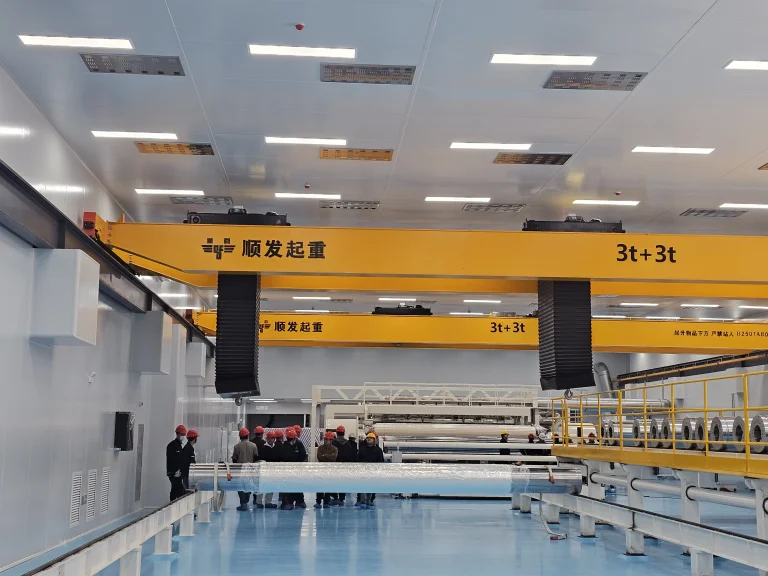
What Changes When a 3t+3t Overhead Crane Works in an Enclosed Clean Production Area?
An overhead crane in an enclosed clean production area has to do more than lift the rated load. It has to remain inspectable and serviceable after the room, the process equipment, and the production schedule are in place. The installation in this case includes two overhead cranes marked 3t+3t above a clean production line. It is a useful reminder that access should be treated as a design requirement, not as a commissioning detail.

Capacity Is Only One Part of the Layout
The load rating answers an essential question, but it does not answer whether the crane will fit the process. A practical layout review starts with the production line below the crane and works upward. Check the hook travel, required headroom, loading and unloading points, and clearance between the lifted item, nearby machinery, guarding, and people.
Where a system has more than one lifting point, the operating method needs the same attention as the rating. The operator must be able to see the lift, avoid side pulling, and know whether the two hooks are intended to work independently or together. The equipment documentation and site procedure should say this clearly.
Maintenance Access Should Be Designed Before Handover
In an open workshop, a technician may be able to approach a crane component from a platform or mobile access equipment. In an enclosed production room, the process line often removes that option. Before handover, identify how a technician will reach current collectors, festoon or cable systems, electrical panels, brakes, limit switches, wheels, and end-truck components.
The question is not simply whether a component can be reached. It is whether it can be reached without removing permanent panels, working above product, or creating an unnecessary production shutdown. A simple access opening, service platform, or planned isolation point can make routine work much less disruptive later.
Keep the Electrical System Serviceable
Cable runs and power-collection components need inspection throughout the crane’s life. The route should protect cable from rubbing, sharp bends, pinch points, and interference with process equipment. At the same time, it must leave enough room for a technician to inspect and replace wear items.
During commissioning, record the condition of moving cables, cable carriers, collectors, terminals, and grounding points. Those baseline records are useful when the crane later develops intermittent travel or control problems.
Match the Crane to the Room Environment
Clean production spaces can place different demands on surfaces, lubricants, housekeeping, and maintenance practices. The project team should define the room requirements early: cleaning methods, airborne contamination limits, restricted materials, washdown exposure if any, and the rules for bringing tools or lift equipment into the room.
The crane supplier, process owner, and maintenance team should agree on these conditions before finalizing component selection. A design that is easy to clean but impossible to inspect is not a finished solution.

Plan the First Inspections Before the First Lift
The handover package should include crane documentation, electrical drawings, rated-load information, inspection points, lubrication requirements, and a practical pre-use and periodic-maintenance routine. Operators should know what to report: unusual travel noise, rough motion, cable damage, inconsistent brake response, loose hardware, and changes in controls.
For an installation in a tight or enclosed process area, it is also worth running the first maintenance task as a dry exercise. The team can confirm whether the stated access route works in practice before production makes every hour of downtime expensive.
Closing Thought
This clean production area installation is a visible reminder that quality is not limited to the bridge and hoist. The best time to solve service access, clearances, and inspection routes is before the process line is fully live. Once the room is producing, a small omission on a layout drawing can become a large maintenance job.
FAQ
What should be checked before installing an overhead crane above a production line?
Confirm the rated load, hook travel, headroom, lifting points, operating clearances, runway arrangement, and the maintenance route to every wear component.
Why is maintenance access important for an enclosed crane installation?
Poor access can turn a simple inspection or replacement into panel removal, work above production equipment, or an avoidable line shutdown.
Which crane components need regular access?
Typical access points include collectors, cable systems, electrical panels, brakes, limit switches, wheels, bearings, and end-truck components.
Can a crane layout be finalized without the maintenance team?
It should not be. Maintenance staff can identify access and isolation issues that are easy to miss on a drawing.
What should operators report after handover?
They should report unusual noise, rough travel, cable wear, inconsistent brake response, loose hardware, control faults, and anything that changes from normal operation.