What Is an Overhead Crane? Types, Uses & Buying Guide for Industrial Facilities
What Is an Overhead Crane? Types, Uses & Buying Guide for Industrial Facilities
Walk into almost any heavy manufacturing plant, steel mill, or large warehouse and you will spot one almost immediately — a steel beam running along the ceiling with a hoist traveling along it, lifting loads that no forklift could ever handle. That is an overhead crane in its most basic form, and once you understand how it works, you start seeing why virtually every serious industrial operation depends on one.
This guide breaks down exactly what overhead cranes are, how they differ from one another, where each type performs best, and what you should evaluate before placing a purchase order. Whether you are equipping a brand-new facility or replacing aging equipment, the details here will save you time — and likely some money.
The Core Concept: What Makes a Crane “Overhead”?
An overhead crane — also widely called a bridge crane or travelling crane — is a type of lifting equipment that moves along a pair of elevated rails (called runways) mounted to the walls or columns of a building structure. The bridge, which is the main horizontal beam or pair of beams, spans the distance between those rails and travels along the length of the building. A hoist trolley rides along the bridge and provides vertical lifting movement.
The result is a three-axis lifting system. The hoist goes up and down. The trolley moves left and right across the bridge. The bridge itself travels forward and backward along the runway. Together, these three movements allow the crane to reach virtually any point within its working envelope — no repositioning the crane, no repositioning the load.
Main Types of Overhead Cranes
1. Single Girder Overhead Crane

The single girder crane uses one main bridge beam (the girder) to support the hoist trolley, which in this design runs beneath the beam on the lower flange. This configuration keeps the hook height relatively low relative to the runway rail elevation, which matters in facilities with limited headroom.
Single girder cranes are typically built for capacities from 1 ton to around 20 tons, with spans from 7.5 meters to 31.5 meters. They are lighter than their double-girder counterparts, meaning runway structures bear less stress and overall installation costs are lower. For workshops, assembly lines, and warehouses where loads rarely exceed 10–15 tons, a single girder crane is usually the economical and practical first choice.
2. Double Girder Overhead Crane

Where loads get heavier or spans get wider, a double girder crane steps in. As the name implies, two parallel beams form the bridge, and the hoist trolley rides on top of the rail on those beams — giving the hook a higher lift height compared to single girder models of the same runway elevation.
Double girder cranes handle capacities from around 5 tons up to 500 tons and beyond in heavy-duty applications like steel plants and shipyards. They can span up to 35 meters or more. They also accommodate specialized lifting accessories — magnet beams, grab buckets, ladle hooks — that would be impractical on a lighter single girder structure. The trade-off is higher initial cost and greater runway load requirements.
3. EOT Crane (Electric Overhead Travelling Crane)
EOT crane is a term used extensively across India, Southeast Asia, and the Middle East to describe electrically powered overhead cranes — a classification that encompasses both single and double girder designs. The “electric” descriptor distinguishes these cranes from older manually or manually-assisted chain-operated models.
Modern EOT cranes feature variable frequency drives (VFDs) for smooth start/stop motion, pendant control stations, and in many cases wireless remote systems. They are the dominant crane category in manufacturing, automotive, and engineering industries throughout South and Southeast Asia.

4. Gantry Crane
Gantry cranes follow the same basic bridge-plus-hoist logic, but the bridge is supported by legs that run on ground-level rails rather than elevated runway beams. This means no special building structure is required — a major advantage for outdoor yards, precast concrete plants, and facilities that cannot support the structural loads of an overhead runway.

Full gantry cranes have legs on both sides. Semi-gantry cranes have one leg on the ground and one end of the bridge riding on an elevated rail. Portable gantry cranes, usually rated under 5 tons, are entirely freestanding and can be repositioned across a floor without any permanent installation.
5. Suspension (Underhung) Crane

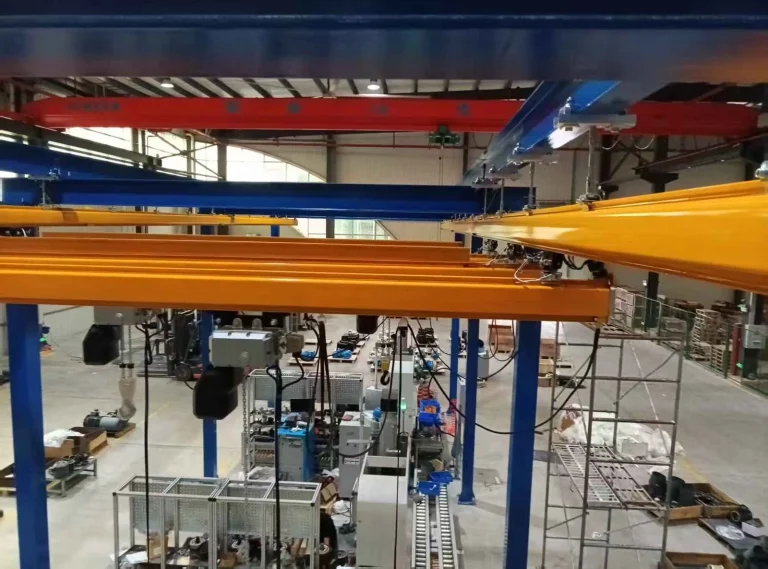
In an underhung or suspension crane system, the bridge itself is suspended from the underside of the building’s roof structure or a dedicated steel framework. The hoist travels below the bridge, and the bridge travels below the runway beams. This design sacrifices some lift height compared to top-running alternatives but excels in spaces where multiple crane systems must share the same building — or where a lightweight, ergonomic workstation crane is needed for assembly and repetitive pick-and-place tasks.
Underhung systems often use KBK-style lightweight I-beam tracks and are popular in automotive assembly plants, electronics manufacturing, and other precision manufacturing environments.
6. KBK Crane System

KBK (Kran-Bau-Kasten, a German term meaning “crane building block”) refers to a modular, lightweight crane system using standardized cold-rolled steel profiles. The system’s strength is flexibility — curved sections, switches, and various hoist options can be combined to create custom layouts that rigid overhead crane systems simply cannot match.
Capacities are modest, typically 50 kg up to 2,000 kg, but that range covers a large portion of assembly, machining, and light manufacturing applications. KBK systems are particularly valued in ergonomic workstation design, where the goal is reducing operator strain rather than lifting enormous loads.
How to Choose the Right Overhead Crane for Your Facility
Step 1: Define Your Maximum Lift Requirement
Start with the heaviest single load you need to move — not the average, but the maximum. Then add a safety margin of 25% to that figure. Undersizing a crane is a safety issue and an operational bottleneck. Oversizing it by a moderate margin is simply good engineering practice.
Step 2: Measure Your Available Span and Height
Span is the distance between the runway rails. Lift height is the distance from the hook at its lowest position to the crane’s maximum raised position. Both dimensions are dictated by your building layout and cannot be easily changed after installation. Measure carefully and account for any obstructions — columns, pipes, cable trays, lighting fixtures.
Step 3: Assess Your Duty Cycle
Crane duty class (classified under FEM, ASME, or ISO standards as A1–A8 or H1–H8) reflects how intensively the crane will operate. A crane used occasionally for maintenance lifts has a very different duty profile from one moving steel coils 200 times per shift. Choosing too low a duty rating leads to accelerated wear and premature failure. A qualified crane supplier will help you map your production cycle to the right duty class.
Step 4: Consider Environmental Conditions
Standard cranes are built for normal indoor environments. If your facility involves elevated temperatures (foundries, heat treatment plants), corrosive atmospheres (chemical plants, coastal facilities), explosive dust or gas (grain silos, paint booths), or outdoor exposure, these conditions require specific modifications — explosion-proof electrical systems, corrosion-resistant coatings, special sealing grades, and so on. Always communicate your operating environment in detail to your crane supplier.
Step 5: Plan Your Controls and Automation Level
Most industrial cranes ship with pendant control stations as standard. Wireless remote controls are increasingly common and eliminate the cable management problems that pendants introduce in complex layouts. For high-throughput operations, semi-automatic or fully automatic crane systems with programmable positioning, load sensing, and anti-sway technology are available and pay back their premium cost rapidly in productivity and reduced operator fatigue.
What to Ask Your Crane Supplier Before Signing Anything
- Can you provide references from customers in similar industries running similar duty cycles?
- What is the lead time from order to installation-ready delivery?
- Do you offer on-site installation, commissioning, and operator training?
- What does the warranty cover, and what are the response time commitments for service calls?
- Are spare parts stocked locally, or does sourcing parts require international shipping?
- Is the design compliant with local safety standards (OSHA, CE, GB, ISO as applicable)?
These questions separate suppliers who deliver a product from those who deliver a working system. The difference matters enormously once your crane is running three shifts a day.
Frequently Asked Questions
How long does an overhead crane last?
A well-maintained overhead crane designed for the correct duty class can operate reliably for 20 to 30 years. Key components like wire ropes, brake pads, and electrical contacts require periodic replacement on schedules defined by the manufacturer and applicable inspection standards, but the structural life of the crane itself is measured in decades, not years.
What is the maximum lifting capacity of an overhead crane?
Standard production overhead cranes typically cover 1 ton to 100 tons. Heavy-duty custom cranes used in shipbuilding, steel production, and power plant construction can be designed for capacities of 300, 500, or even over 1,000 tons. Capacity is ultimately an engineering and budget question rather than a hard technical ceiling.
Do I need special permits to install an overhead crane?
Requirements vary by country and jurisdiction, but in most industrial markets some form of regulatory approval, third-party inspection, and operator certification is required before a new crane can enter service. Your supplier and a local crane safety inspection body can clarify the specific requirements in your location.
If you would like specifications or a quotation for any of the crane types described here, our engineering team is available to assess your facility and recommend the optimal configuration. Submit your requirements through our inquiry form and we will respond within one business day.