One Factory, Five Crane Ratings: Matching Capacity to Each Assembly Bay
The first thing that stands out in this equipment assembly workshop is not the largest crane. It is the range of capacity markings above neighboring production bays.
The site photographs show 5t, 16/3t, 20/5t, 25/5t and 32/5t cranes working under the same factory roof. That is a useful reminder for anyone planning an overhead crane system: one factory rarely has only one lifting problem.
The lighter bays handle routine assembly work. Other bays need a larger main hook and a smaller auxiliary hook for positioning. Instead of specifying the same crane everywhere, the lifting plan follows the parts, fixtures, assembly sequence and building structure in each bay.
Project at a Glance
| Item | What the site record shows |
|---|---|
| Facility | Multi-bay equipment assembly workshop |
| Crane ratings visible in the photographs | 5t, 16/3t, 20/5t, 25/5t and 32/5t |
| Layout | Separate overhead crane runways serving different production bays |
| Work below the cranes | Machine frames, modules and assembly stations |
| Main planning issue | Match capacity and hook coverage to each bay without overloading the building or overspending on light-duty areas |
The capacity markings are visible on the crane bridges in the project photographs. Span, lifting height, duty class and travel speed are not included here because they cannot be confirmed from the photo record alone.
Why the Crane Ratings Change from Bay to Bay
1. Capacity starts with the heaviest verified lift
A crane should be selected from an actual load list, not from the largest machine name in a brochure. The calculation needs the part, lifting beam or slings, fixtures and any temporary tooling that will travel with the load.
The heaviest lift also needs to be tied to a location. A 25t component in one assembly bay does not automatically justify a 25t crane over every workstation in the building.
2. Main and auxiliary hooks serve different jobs
The 16/3t, 20/5t, 25/5t and 32/5t markings show that the heavier bays were planned with a main and auxiliary lifting capacity. The smaller hook can handle lighter parts and help with controlled positioning while the main hook remains available for the heaviest lifts.
For equipment assembly, that can be more practical than using the large hook for every task. The correct arrangement still depends on whether the two hooks must work independently, together or only at different stages of assembly.
3. The building is part of the crane design
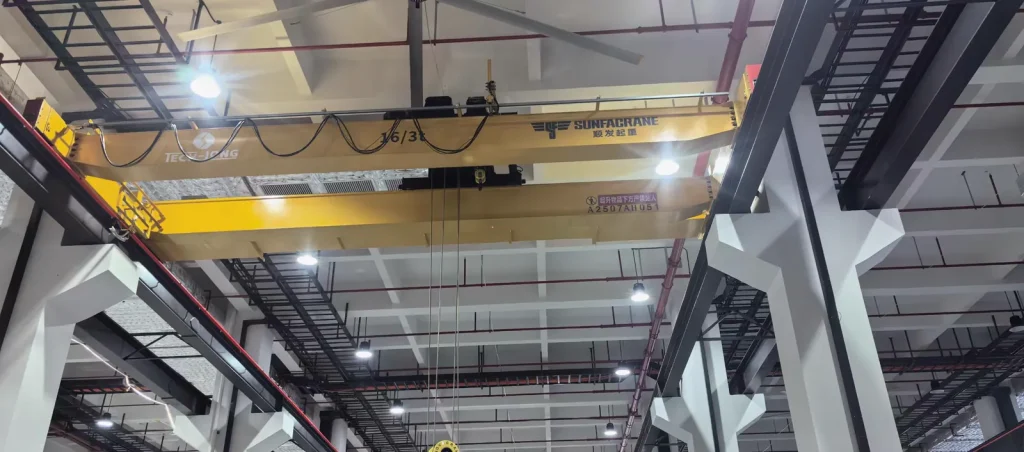
The photographs show crane runways beside concrete columns, with lighting, fire piping, cable trays, ventilation ducts and large ceiling fans occupying the same overhead space.
These services cannot be treated as background details. They affect hook height, end approach, maintenance access and the safe clearance around the bridge and hoist. Moving a runway or lowering a crane after these systems are installed is far more difficult than coordinating them during drawing review.
4. Lighter bays do not benefit from unnecessary capacity
The 5t crane serves a visibly lighter production area than the bays fitted with 16t to 32t main capacities. Using the largest crane specification across the whole building would add wheel loads, runway steel, electrical demand and maintenance cost without improving the work done in the lighter bay.
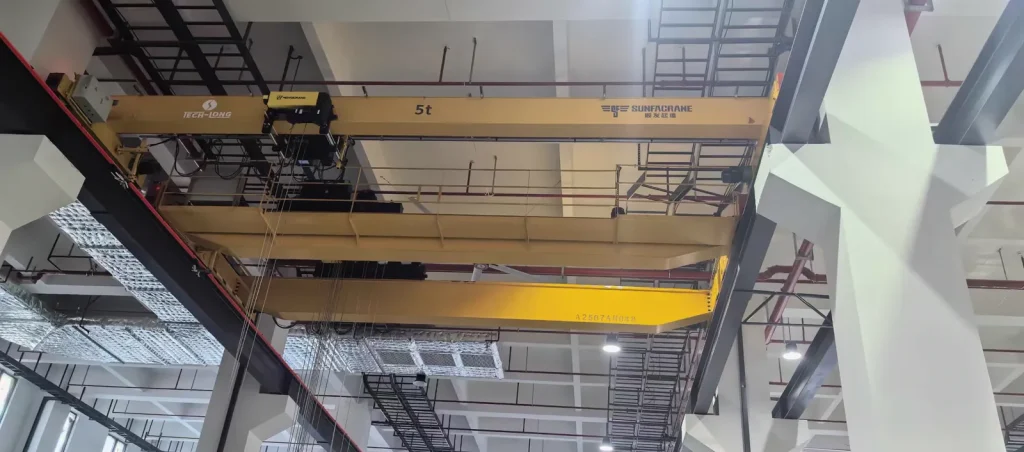
The practical saving comes from making a capacity map for the factory, then selecting the crane for each zone. This is also how we approach a broader manufacturing industry crane review.
What the Site Photos Tell Us
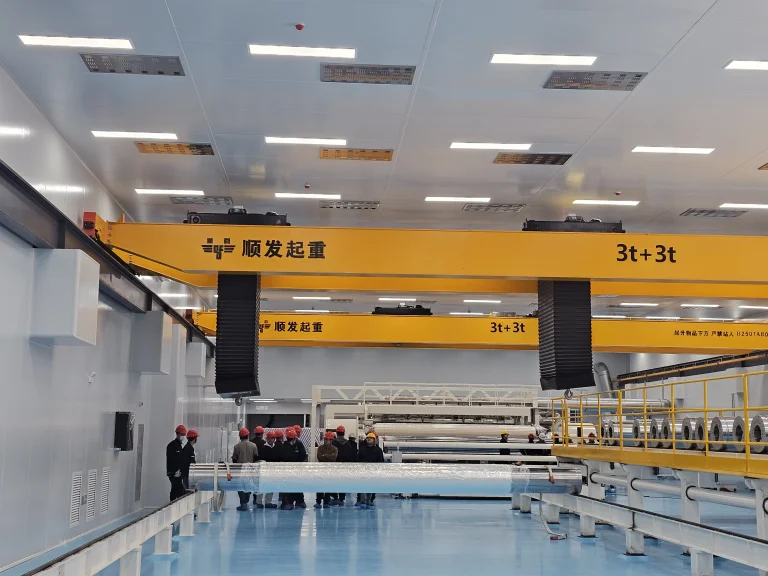
The wide workshop view shows several crane bays above active assembly stations. The runway beams sit close to columns and building services, so hook coverage and clearance had to be considered together.
The 16/3t crane is positioned over a bay where a main hook and a smaller auxiliary capacity are available. The bridge, runway and power route are integrated around the existing building grid.
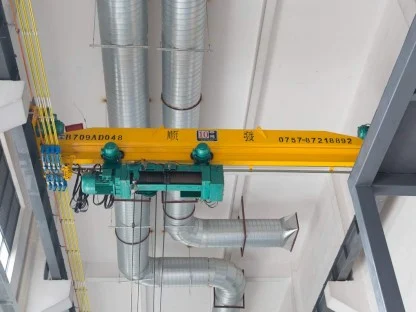
A separate 5t crane covers lighter handling work. This is the clearest example of why one factory-wide capacity would have been wasteful.
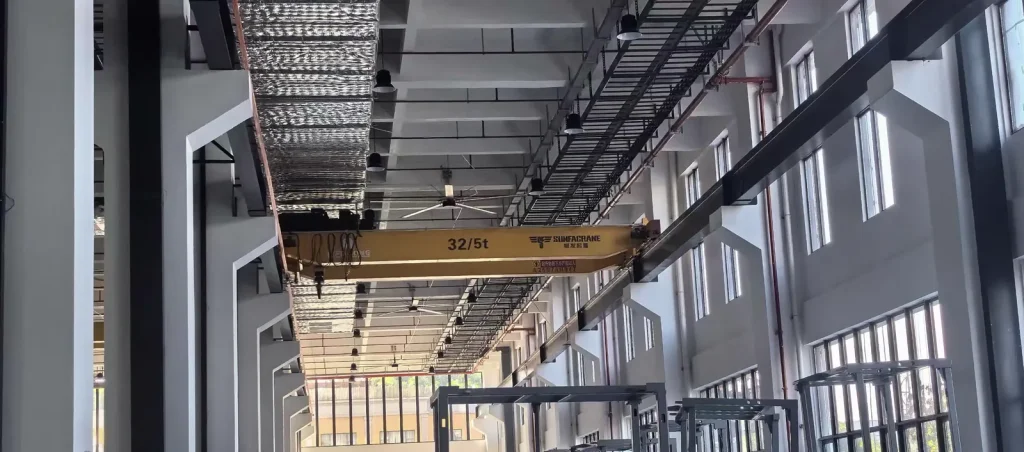
The 32/5t crane serves one of the heavier bays. Its main and auxiliary ratings give the production team two useful lifting ranges without applying that structure to every bay.
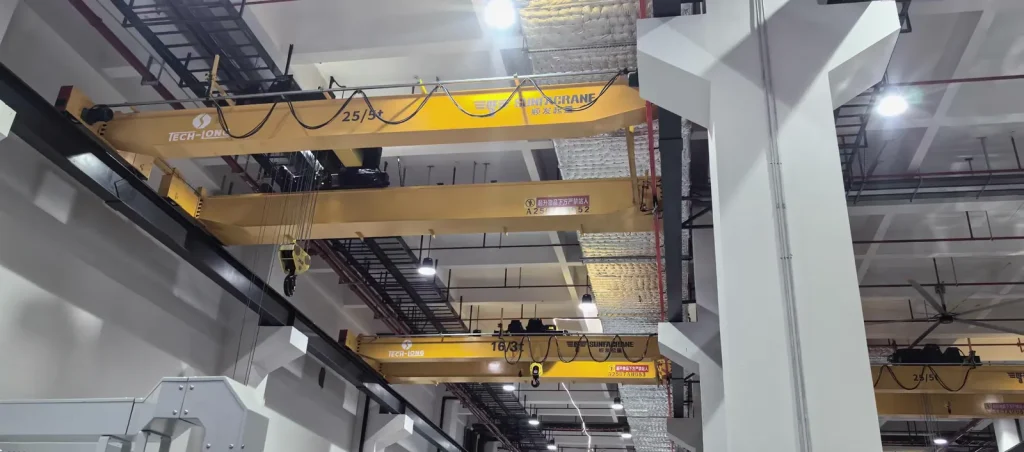
Another view records 25/5t and 16/3t cranes in neighboring production zones. Capacity follows the work carried out below each runway. More completed installations can be seen in the project gallery.
How We Would Quote a Similar Workshop
Before recommending a single girder crane, double girder crane or a main-and-auxiliary arrangement, we would ask for the following details. The crane quotation requirements checklist gives buyers a practical starting point.
- A building drawing with column grid, runway elevation and clear height.
- A bay-by-bay load list, including rigging and fixtures.
- The pickup and set-down points for the heaviest parts.
- Expected lift frequency, travel distance and operating hours.
- Machines, platforms, ducts and services that limit hook access.
- Whether a smaller auxiliary hook is needed for assembly or positioning.
- Control preferences and the normal position of the operator.
- Planned equipment changes that may raise capacity requirements later.
These inputs are more useful than asking only for tonnage and span. They allow the crane layout to support production instead of becoming another obstacle above it.
Single Girder or Double Girder?
The answer should follow the bay, not a factory-wide rule.
A single girder overhead crane can be the sensible choice for a lighter bay when its capacity, span, headroom and duty are suitable. It keeps the structure straightforward and avoids adding weight that the process does not need.
For heavier capacities, demanding duty, tighter hook-height targets or main-and-auxiliary lifting, a double girder overhead crane may provide the better arrangement. Final selection still depends on the runway, trolley design, hook approach and the building loads.
The photographs from this workshop are valuable because they show both ends of that decision in one facility.
Questions Buyers Usually Ask
Should every bay in a new factory use the same crane capacity?
Usually not. Standardizing components can help maintenance, but capacity should still be based on the heaviest verified lift and operating duty in each bay. Oversizing every crane increases structural and lifecycle cost.
What does a rating such as 20/5t mean?
It normally identifies a 20t main lifting capacity and a 5t auxiliary capacity. The operating logic, simultaneous-use rules and hook arrangement must be confirmed in the technical specification.
What should be added to the load before selecting crane capacity?
Include the lifted part, slings, lifting beam, fixtures and any tooling carried with the load. The load case must also be checked against duty, travel and site conditions.
The Practical Takeaway
The most useful lesson from this project is simple: do not start with one crane model and copy it across the factory.
Start with a bay-by-bay lifting plan. Record the heaviest load, the normal daily lifts, the required hook positions and the building constraints. Then decide where a 5t crane is enough and where a 16t, 20t, 25t or 32t main capacity is justified.
For a project review, send the building drawing and load list through the contact page. SUNFACRANE can compare the runway layout, hook coverage and crane type before the workshop steelwork and services are fixed.