Container Yard Crane Selection: 8 Details to Confirm Before Quotation
A container yard crane is not selected from lifting capacity alone. The machine has to fit the way containers enter, move through and leave the yard. A crane that looks suitable on a specification sheet can still create traffic conflicts, poor truck access or unnecessary civil work when the operating layout is not defined first.
When we review a container-handling enquiry, the useful starting point is a yard drawing and a description of the work cycle. The eight details below give an engineering team enough context to discuss the right crane arrangement instead of sending back a generic model list.
1. Define what the crane must handle
Start with the container types and actual load cases.
- Will the yard handle 20 ft, 40 ft or 45 ft containers?
- Are the containers loaded, empty or a mixture of both?
- Is the crane stacking containers, transferring them between rail and truck, or serving a production and storage area?
- Does the operation require a standard spreader, a rotating spreader or another lifting attachment?
The maximum gross container weight matters, but it is not the only load in the calculation. The spreader, headblock and any special attachment travel with the container and must be included in the crane design.
For a purpose-built system, see our container gantry crane page. A general outdoor gantry crane should not be assumed to be suitable for container service without checking the spreader, duty, positioning and safety requirements.
2. Map the container flow before choosing the crane type
The crane should support the yard traffic plan, not force the yard to work around the crane.
Mark the following areas on the layout:
- rail tracks and truck lanes
- container stacking rows
- loading and unloading positions
- maintenance access
- pedestrian exclusion zones
- future yard extensions
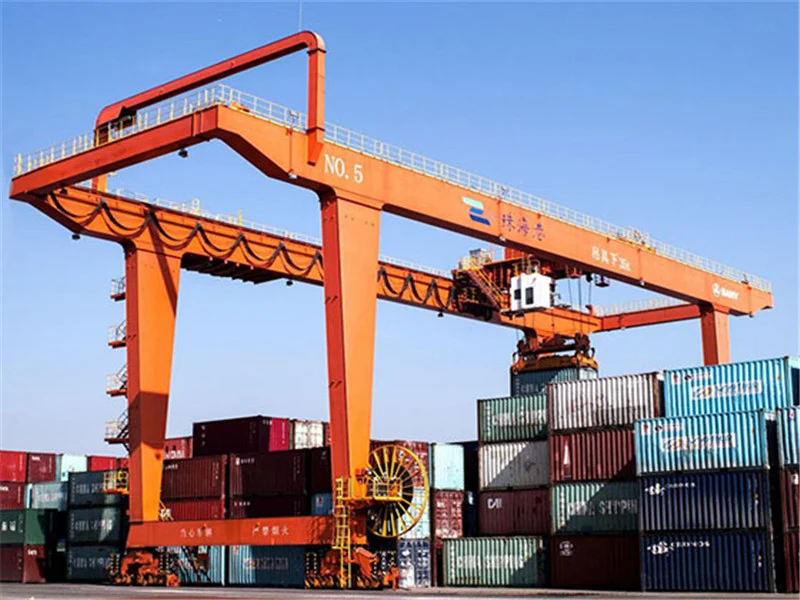
A rail-mounted gantry crane follows a fixed runway and is often a practical choice for a defined transfer zone, intermodal terminal or high-density stacking block. A rubber-tyred gantry crane can move between blocks and offers more flexibility when the traffic pattern changes.
Neither arrangement is automatically better. A fixed, repeatable flow usually favors a fixed crane route. A yard that must regularly change blocks may place more value on mobility.
3. Confirm span, cantilever and truck-lane coverage
Span should be calculated from the required working area, not copied from another terminal.
The layout needs to show how many container rows, rail tracks or traffic lanes sit under the crane. It should also identify whether truck loading takes place inside the main span or under a cantilever.
The end approach matters as well. A crane may have enough overall span but still leave an unusable area near the legs or runway ends. For that reason, the quotation drawing should show the hook or spreader coverage, not only the outside dimensions of the steel structure.
4. Set the stacking height and lifting clearance
Container stack height is only one part of the lifting-height calculation. The crane also needs clearance for the spreader, headblock, container pickup and safe travel above the stack.
Provide:
- the maximum number of containers to be stacked
- the highest container type used in the yard
- the required clearance above the top row
- any height restrictions from nearby buildings, power lines or port equipment
If trucks or railway wagons pass below the crane, their operating envelope must be included. This is especially important when the loading position and the stacking block have different ground levels.
5. Describe the real operating duty
The same rated load can produce very different crane designs depending on how often the crane works.
An occasional lift in a storage yard is not the same duty as continuous container transfers over several shifts. The engineering review needs expected moves per hour, working hours per day, shifts per day and the proportion of loaded and empty moves.
Travel distance also affects the duty. Long gantry travel, frequent acceleration and repeated positioning can be as important as the hoisting cycle when drives, brakes, wheels and electrical components are selected.
Avoid choosing a working class from the crane price alone. A lower initial specification can become expensive when motors, brakes or wheels are asked to operate beyond the duty for which they were selected.
6. Decide how the crane will be powered
Power selection affects both the crane and the yard infrastructure.
Rail-mounted cranes are commonly designed around an electrical supply through a cable reel, conductor system or another fixed power arrangement. Rubber-tyred cranes may use diesel, hybrid, battery or external electric power depending on the operating model and available infrastructure.
Before quotation, confirm:
- site voltage and frequency
- available power capacity
- preferred cable or conductor route
- acceptable emissions and noise levels
- backup expectations during a power interruption
The cleanest option on paper is not always the easiest retrofit. Existing pavement, drainage, traffic lanes and substations all influence the practical cost.
7. Record wind, corrosion and site conditions
Outdoor container cranes need a site-specific environmental specification.
Provide the project location and any available design data for operating wind, storm wind, temperature, humidity, rainfall and seismic conditions. Coastal terminals should also identify the corrosion environment so that the coating system, fasteners, electrical enclosures and maintenance plan can be selected accordingly.
Storm anchoring, rail clamps, tie-downs and wind alarms are not accessories to add at the end of the project. They are part of the crane and civil interface and should appear in the technical discussion from the beginning.
For a broader view of equipment used in ports and logistics yards, visit our port crane and yard handling solutions page.
8. Plan control, positioning and future automation
The required control level should match the yard operation.
Some projects need a cabin-operated crane with clear visibility and reliable communications. Others need remote operation, anti-sway control, container positioning, stack profiling or an interface with the terminal operating system.
Automation is easier to plan before the rails, power distribution and communication network are fixed. Even when the first phase will be manually operated, it is worth deciding whether later phases may require remote control or automated moves. The answer can affect sensors, data networks, drive systems and equipment layout.
Information to send with a container yard crane enquiry
A useful first enquiry does not need a finished engineering package. It should include enough information to establish the load path and operating environment:
- yard plan with dimensions
- container sizes and maximum gross weight
- stacking rows and maximum stack height
- rail and truck lane positions
- required span, cantilever and travel length
- daily operating hours and estimated move frequency
- available power supply
- wind and environmental data
- preferred control method
- photographs or drawings of the existing site
- expected installation schedule
If some values are not yet confirmed, mark them as open items rather than estimating them as facts. That makes it easier to identify which decisions require a site survey or drawing review.
Common questions
Is a rail-mounted crane always better for a container yard?
No. A rail-mounted gantry crane suits a fixed route and repeatable yard layout, while a rubber-tyred crane can offer more mobility. Throughput, civil work, power supply, traffic flow and future expansion should be compared together.
Can a standard gantry crane lift containers?
Only after the complete duty and lifting arrangement have been checked. Container handling normally requires a suitable spreader, accurate positioning, anti-sway performance, appropriate working duty and safety controls. Changing the hook does not by itself turn a general-purpose gantry crane into a container handling system.
Can a container yard crane work over railway tracks?
Yes, when the span, clearances, rail interface, truck transfer area and operating controls are designed for the terminal. The railway operating envelope and local safety requirements must be included in the layout review.
What determines the price of a container gantry crane?
The main factors include load and spreader arrangement, span, lifting height, cantilevers, travel length, duty, power system, control level, environmental design, civil interface and installation scope. A price based only on tonnage is rarely a reliable project comparison.
Start with the layout, not the model number
The most productive first step is to put the container flow, truck or rail interface and stacking plan on one drawing. From there, the crane type, coverage, lifting height and control system can be discussed in practical terms.
Send the yard plan and expected container flow through our contact page. SUNFACRANE can review the working area, identify missing design inputs and prepare a container handling crane proposal around the actual site.